
Black Hat put out a call for playtesters for an upcoming game – Tomb Raider – Shadows of Truth and managed to get in on it. This was no quickstart – it was a 278 page tome plus playbooks and other support material but I still managed to get it to my regular Saturday Night table before the deadline.
I printed off as supporting documents for the players, improvised myself a Keeper’s Screen, set up multiple copies of the playtest material for a player to help co-pilot, and grabbed one of the simpler adventures provided in the back of the book and we sat down to play …
Things we liked …
Powered by the Apocalypse games are very big on using questions to drive games. My players really enjoyed the prompting questions, both for character creation and within the adventure itself. It really helped build a narrative that the players invested in with hooks of their own.
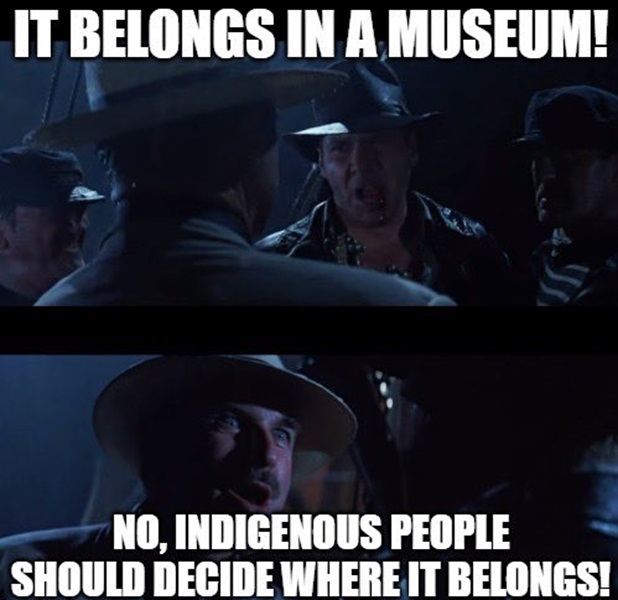
The narrative shifts away from tomb raiding and treasure looting, something that’s gotten a lot of pushback on the internet. As a game of the early 21st Century, it’s to be expected that it’s less “This belongs in a museum” and more “This belongs where it can be appreciated and studied by the culture it came from” and the final choice of returning an artifact or keeping it for ‘reasons’ (even if they are good reasons) have consequences for the characters. The important thing is keeping it away from the Bad Guys (Corporations, Conspiracies, Megalomaniacs bent on using the artifacts for their own wicked ends)
The playstyle seemed to us to be pretty fitting to the elements of the franchise, Laura Croft Tomb Raider, with a focus on traps, puzzles, and evil conspiracies that stand in your way more than what happens to the mysterious artifacts after they are recovered. Like many PbtA games, player characters have mechanics to help player characters, specific moves to approach the challenges, and failures creating new challenges that advance the plot either for the PCs or their rivals. The flashback mechanic is less about preplanning and more about cinematic cutscenes that reveal secrets of the artifact and the progress of those nasty rivals towards the final goal.
The creation of your team builds up questions that build bonds and shape their motivation as well as define their special moves. It also informs details about your primary rival and why they want the artifacts. For example, my group decided that Breakers of the Conspiracy sounded the most fun (the others in the play test were Raiders of the New Age, Guardians of Our Community, and Heirs of Atlantis). Most of the teams acknowledge that previous raiding was a mistake and their motivation is to correct wrongs and strengthen communities. I found myself reminded of source material like Tomb Raider & Carmen Sandiago (current animated series), Assassins Creed, and National Treasure with the descriptions of each team.
You aren’t play Lara but the playbooks easily connect to phases of her own life and those frequent NPCs that assist her in her quests.
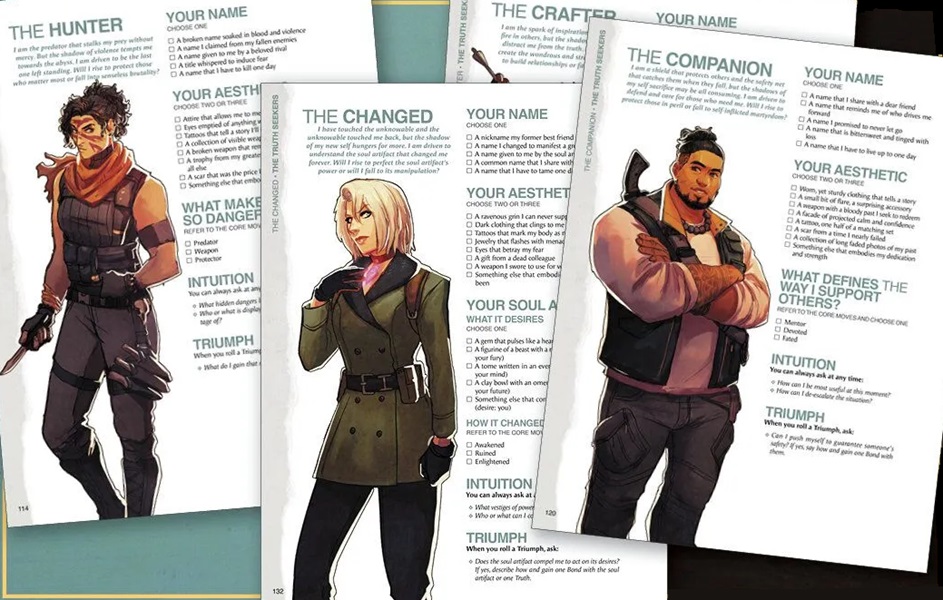
The dice pools you build are closer to Forged in the Dark than PbtA, using 6s as a success, 4-5 as limited, and 1-3 as a Crisis. By answering questions from the Move, you add up to 2 more dice. If you can apply your Seeker Questions (specific to each playbook), add another dice. Your Bonds and Gear can add more dice. And finally, clues you have discovered / created through moves – Map, Lore, Aid – can be spent. There’s even a Shadow Question that can add a 6th die to the usual maximum 5 dice in a pool, as the Shadow is a special condition where your character has fallen so deep into their shadow self (shades of World of Darkness!) that comes with advantages but at an overall cost.
What we improvised …
There wasn’t much guidance in terms of completing a complex task like should it be one roll / move to save all the townsfolk from a horrific storm or a series. We used a clock system ala Blades and it seemed to work well enough. I’d been using a similar system for skill challenges in D&D but the clock has a certain elegance and a sense of sand running down the hourglass.
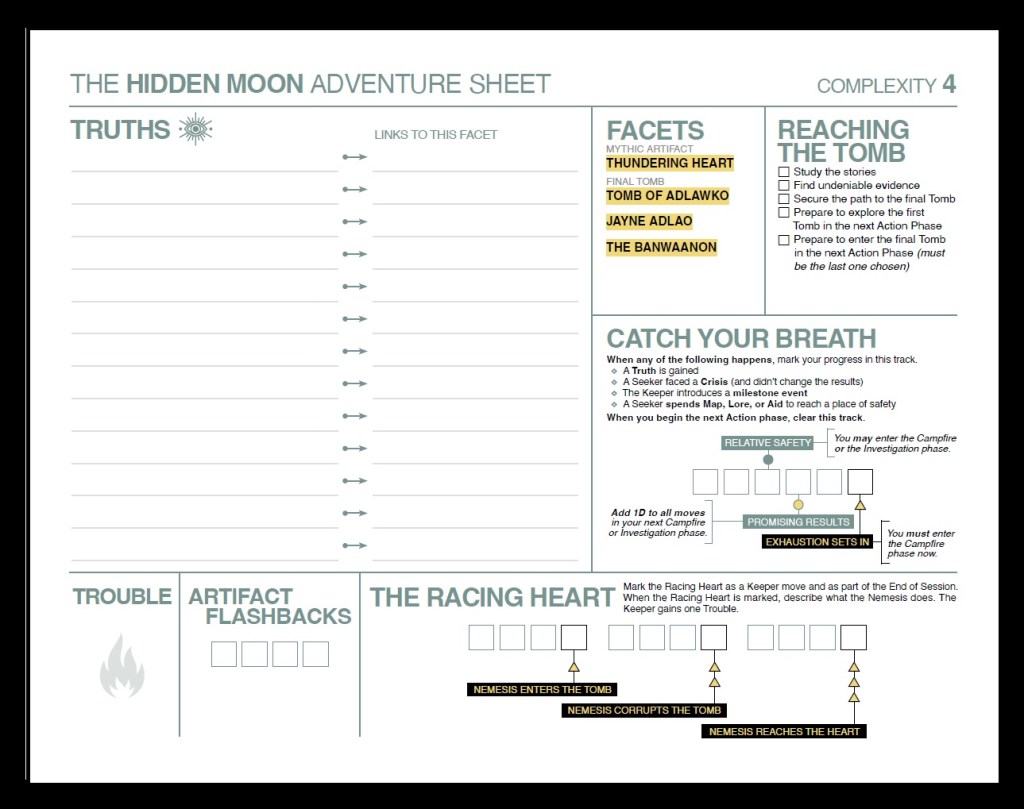
Each adventure has an adventure sheet to track Truths (a series of provided clues that would eventually unlock the Final Tomb) and The Racing Heart (progress towards to Heart of the Tomb, both the Team’s progress and that of the Nemesis). I printed out an 11×17 version for ease of reading it from across a table and to give plenty of room to write in the details. Several post it notes were used to track details revealed through flashbacks and cutscenes, creating an extension from the main sheet. The Progress portion was something that was going to be used several times so we used little plastic cubes to represent ticked boxes on that track. I liked the layout it took on and might try to adapt it for some investigation games like Call of Cthulhu and Brindlewood Bay (if I ever manage to get that latter one to the table – picture Murder She Wrote tracking down cultists engaged in eldritch acts).
With this we took issue …
The layout of the book wasn’t the greatest. Yes it had some bits missing like an index but at least there was a table of contents at the beginning. However we found it frustrating to work through the frontloading of the mechanics and phases for the first 100 pages before getting to what a character looks like (about 60 pages for PCs and Teams) and Keeper/Gamemaster section (less than 20) and the anatomy of an adventure (about 10 pages). We spent a great deal of time flipping between pages and searching for key terms and wishing deeply that there was a glossary for commonly used game terms.
For those annoyed at the ‘minigames’ and different game phases of Blades in the Dark, they will experience even more of the same. There is a separate phase for Action, Campfire, and Heart of the Tomb, each with it’s own set of Moves. We rushed some through the individual Tombs and the final Tomb and worked co-operatively to figure out if we were using the system correctly.
It is only a playtest, so it’s understandable that there are pieces missing and edits that will need to be made. I also would hope that there will be a more constructive guide to creating your own adventures though that might wind up as it’s own separate handbook, probably titled “Lost Artifacts & Forbidden Places” or similar.
Final Thoughts
We enjoyed it and would play again. Final price point is likely the make or break for adding it to the collection but I’m not sure how often we would get it to the table.
I am curious that when the final release comes out, will they attempt to have a quick start booklet, and if so, will they be able to condense it down to 64 pages or less, hopefully with a starting adventure.
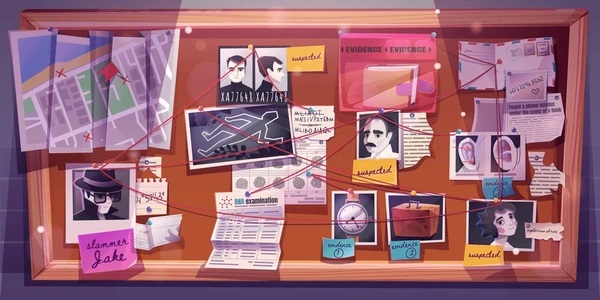
Meanwhile, I’m taking some inspiration from the system and setting and seeing about using them in some form for a Pulp Call of Cthulhu game I’ll be running this year. I’m still working out the finer details, but part of the plain is to write significant clues on index cards and attempt to organize them on something similar to the Adventure Sheet from this system. There may eventually be something that looks more like a conspiracy board, showing connections between clues or like the clue maps that was included with Masks of Nyarlothotep, but something to make them easier to sort organize and physically manipulate.
Discover more from A Geek for All Seasons
Subscribe to get the latest posts sent to your email.
 A Geek for All Seasons
Is this aimed mainly at one-shots or have they included a means for character advancement?
LikeLike
TLDR – Yes, the system does have character advancement built in, though an advancement could happen mid adventure but more likely to happen over two or more adventures.
Long Answer – Taking my best guess, they are definitely looking at campaign play based on things like the relationships with the cultures that are home to the artifacts and with the team nemesis. It being largely rooted in Powered by the Apocalypse, once a PC has ticked enough boxes of experience, the available advancements include unlocking new moves (or actions) from your own playbook or from another playbook, gaining new prompt questions (which give more ways to add extra dice to your dice pool, still limit of 5 max in most situations), gaining a new condition option (so can take more hits), or gain a new piece of gear. There is a limit as to how often each of these can be taken over a PCs adventuring life before they retire. Additionally, in the test adventure that we played, depending on how it ended would add to the character playbooks a new bond or condition.
Could it still be played as a one shot? Sure, though the mechanics of different play modes as they are in the play test are not the most intuitive to most forms of play but that might get streamlined in the final copy. Creating a character is quick and simple – choose a playbook, answer three questions about the PC background and motive and connections, and tick a few boxes for playbook moves, and good to go (assuming the GM walks the players through their first couple of dice pools for moves made, something that in most PbtA games is a conversation about what the player wants to happen and the appropriate roll).
LikeLiked by 1 person
Fantastic answer. Thanks for taking the time to explain.
LikeLike
Glad to! There’s a lot going on in this system but there is some good stuff in the mechanics. In some ways I’m reminded how Daggerheart contains the mechanics of at least three other games
LikeLiked by 1 person