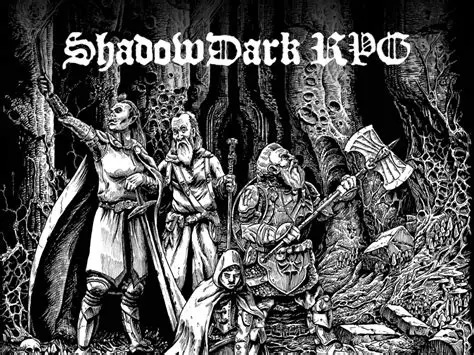
Last week we had too many people for Frosthaven but were still missing enough to play our ongoing Dragonlance Shadow of the Dragon Queen campaign. My table was kind enough to let me run a quick adventure using the ShadowDark RPG ruleset. I’d been following the system since the quickstart and crowdfunding campaign, had been listening to dungeontuber reviews and the Glass Cannon Network liveplay, and had even been backing some resources like Treasures from the Dark and an Adventure Anthology. An advantage of such a back to basics game is that it’s pretty simple to port it over to another d20 game. Meanwhile, it was another New Game / Not D&D Game towards my Gamer Goals for the year.
Unlike the one shot Dungeon Crawl Classics funnel that I ran some time ago, our goal wasn’t to experience how brutal the system was but to take it for a spin and try out some of the features (in my humble opinion, the funnel mechanic of DCC is one of it’s features, less so in ShadowDark even though it does have a level 0 funnel as an option). Thus, we rolled up two characters per player (providing options and a back up just in case), picked one to level up and equip (rolling 4d6 x 10 gold) and started with a free carousing roll before setting off on a crawl. Carousing is definitely one of the features of the system, providing a way to spend gold and score some random XP towards levelling a some story connections. We had experienced something similar in the 2d20 Conan system, again an abstraction of spent downtime while handwaving time and additional expenses.
I ran an adventure out of the Adventure Anthology (and yes, it was a little railroad driven but for a one shot I believe that it’s okay to be direct in setting the goal) and we dutifully tracked rations spent and rolled for random encounters per hex and per watch. Currently, I’m not the greatest fan of tracking things like rations and getting bogged down in purely random encounters but again, this was a feature of the system, emphasising something more grim and survivalist without getting too lost in the granularity. So far, it’s simple enough that I’m comfortable with it, watching player reaction to gaining more slots when they cross off another ration but suddenly weighing the consequences of spending half the day foraging for more rations or pressing on to the destination. Previously, we’ve been mostly playing heroic high fantasy D&D 5E campaigns, where most random encounters start to lose their bite as the PCs level up and tracking rations is usually moot with a ranger in the party, so this was a significant change in our approach to dungeon crawling.
I’ll say this for ShadowDark, they really encourage you to roll only when needed and to be ready to improvise rolls in response to player creativity. A slim rulebook means few mechanics and we might have missed some subtler points as we got fast and loose with improvised actions like yanking a berserker out through a window with a strength roll and convincing the hungry ogre not to eat someone – and yes, both happened. It’s a GM approach I’ve been trying to improve on with other games like Blades in the Dark and Pirate Borg while attempting to apply it to D&D, but there are many subsystems in D&D for all manner of encounters which do create a dependable regularity to the mechanics but subconsciously shape how we play.
We used a few house rules to crank up the pulpy action.
- Start the session with 1d4 Luck Tokens and expand their uses to include: reroll any of your dice, maximize one effect (damage, healing, duration, etc.), or minimize an enemy’s critical hit. (I stole most of this one from Pirate Borg‘s Devil’s Luck)
- Escalation dice: After missing a significant d20 roll (i.e. combat or something critical that you couldn’t just try again without consequence), gain a d6 that you could add to any of you rolls (d20 test, damage, healing, etc.). You could gain up to three escalation dice and you could spend them one at a time after the roll, up to all three at once. (I heard about this on Sly Flourish and as a frequently bad roller, I wanted to try it out)
- Start with maximum hit points at first level, roll randomly for each level after. (ShadowDark option)
- Gain XP for monster hunting or otherwise overcoming a challenge. (ShadowDark option)
- Spellcasting despite failure at a cost – rolling a consequence as if the spell had critically failed. After the first failure, the caster would have to rest to recover as per usual or face a critical failure even on a success. (a slight variation on a house rule I had been using in Pirate Borg and Call of Cthulhu, giving a little more agency over making a spell happen but not without paying for it. I have since come across a house rule suggesting the caster take damage equal to the tier of the spell being cast, so I’m thinking about this as an alternative)
As is the case with any game, how many house rules can you add before you might as well be playing a different system that already has those rules? I feel pretty good about these ones before falling into the trap of creating an entire supplement of just house rules for our table.
Features that we didn’t really test out included the opportunity for proper hex crawl of discovery, character death counters, and the torch light timer. The adventure path was fairly direct but there were hints of potential side quests and ruins to explore at a later date. We had one character drop to zero and another drop to one, but the cleric managed to heal up the dying character even before they had rolled the death counter. Despite that, there was a great deal of caution as they realized quickly just how fragile their low level characters were, particularly with the level of armor they were using. As for the torch light timer, the adventure locale was encountered while there was still light and only a few times were they in a full darkness situation. I did start the timer, but the encounters were long done and campfire for the night set up before the timer ever ran out.
The final verdict of the table was yes, they would play again and they did enjoy the raw simplicity of the mechanics. ShadowDark delivered much as promised on the tin. Thus, I am starting up a Dollarama journal of brainstorming ideas for a limited set of one shots for future occasions and setting up homework for some of the aspects that were left very wide open, like what about buying a cart to carry extra gear …
Discover more from A Geek for All Seasons
Subscribe to get the latest posts sent to your email.
 A Geek for All Seasons