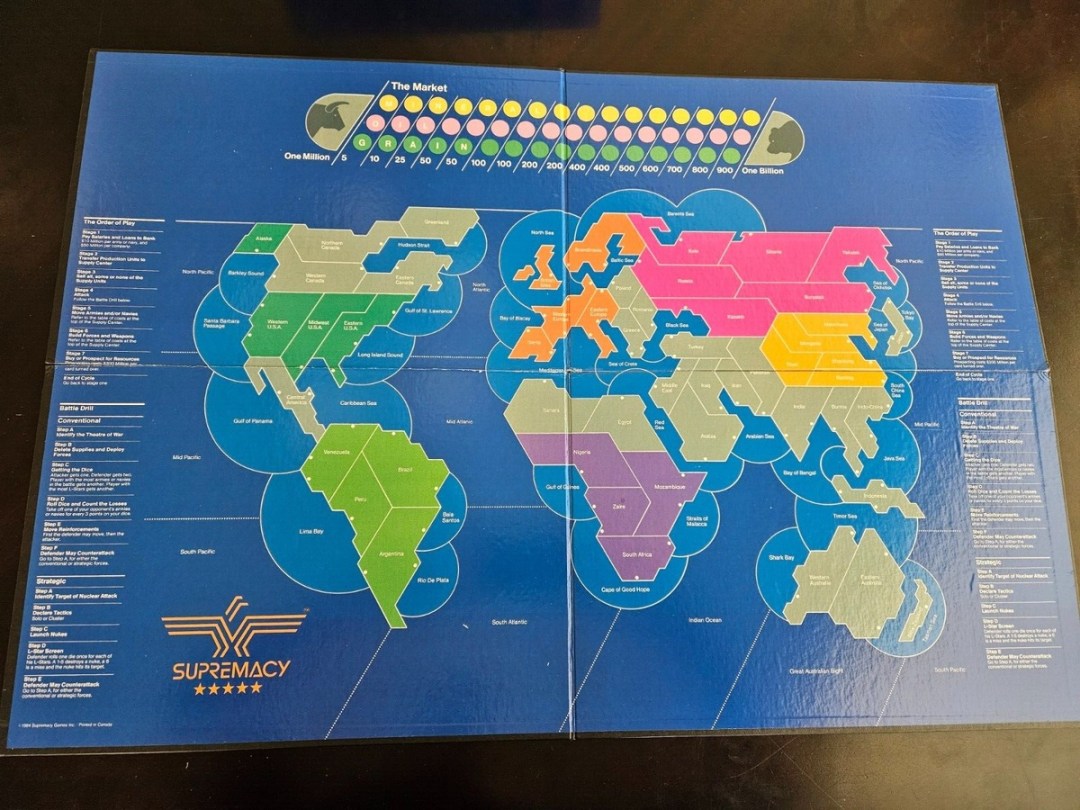
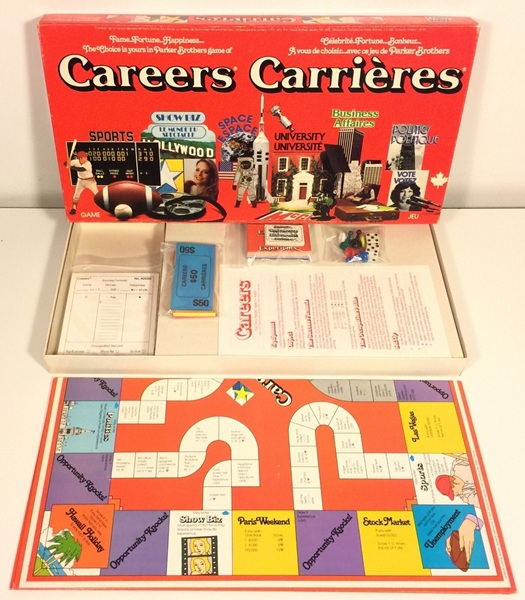
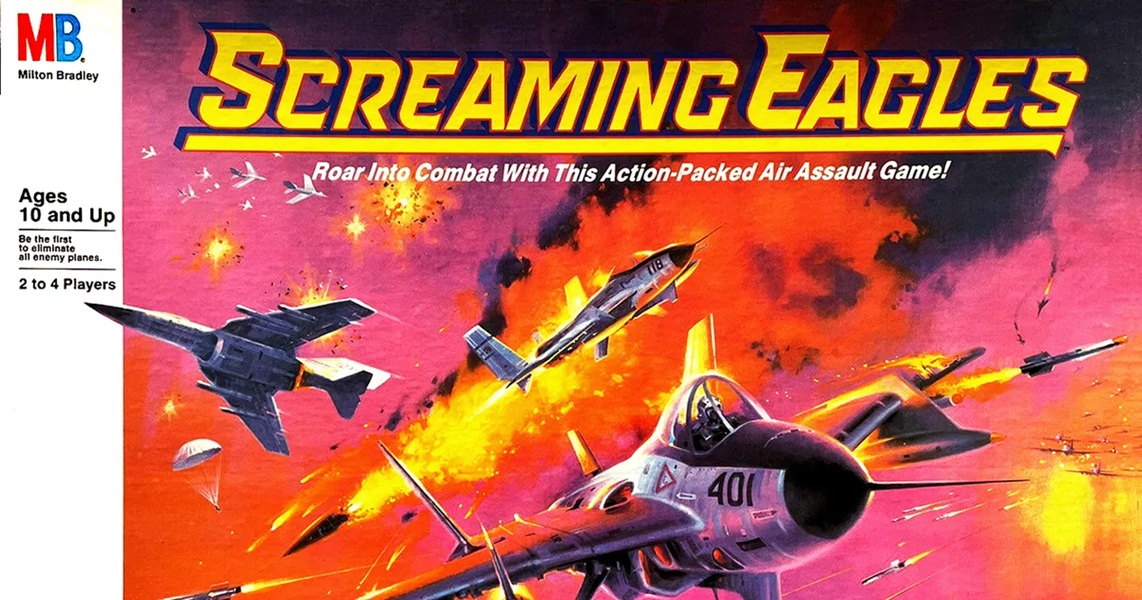
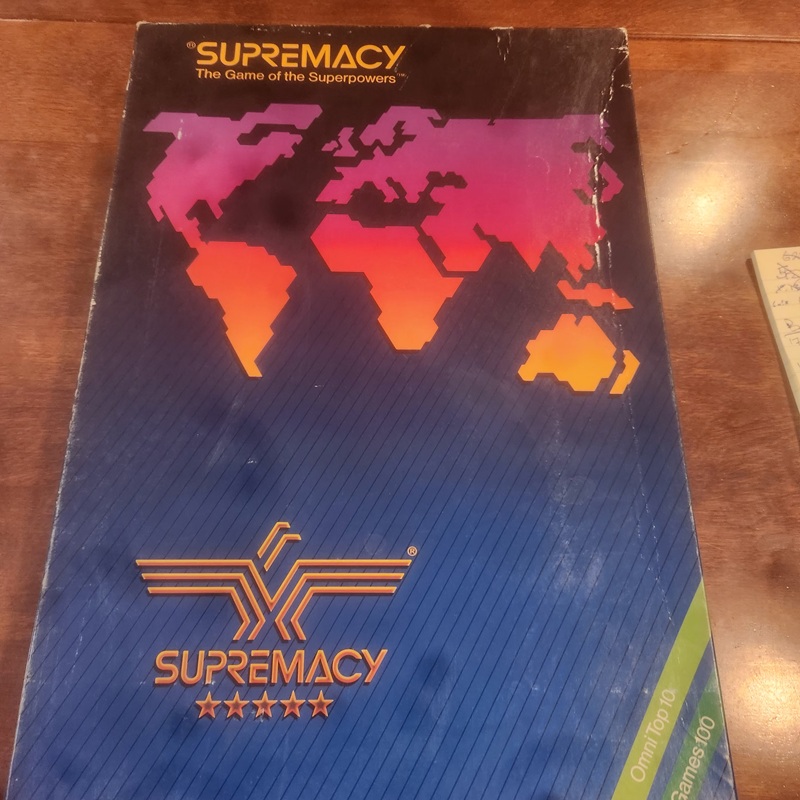
There are some old school games like Careers and Screaming Eagles that will always have a special place in my heart and on my game shelf. Supremacy was a game that I saw played at the University game club, but I never managed to get in on a game. For a long game it had a mythic quality in my mind, having nukes and an economy track mashed with a very RISK like game. When I found a used copy that wasn’t too expensive, I grabbed it, only to have it sit unplayed for several more years until I managed to finally bring it to a table.
The Pitch
Imagine if you would, the global war of RISK with an economic market mechanic and a splash of political wheeling and dealing to consolidate your power and cash generating corporporations, plus the threat of nuclear escalation.
For a board game of the 80s, that’s pretty heady stuff. It had several supplements and rules expansions, but I found there was enough in the base game to keep me entertained.
The Components
Each player has their own mini board to track resources generated by controlled corporations, selling to the market, and bargaining with other players. The resources are primarily used to create new units (armies, ships, nukes, orbital lasers). Resources are tracked by moving counters up and down the tracks. Each corporation produces one or more resources for the player that occupies the region listed on the cards. Building costs are listed right on the card, which is always appreciated.

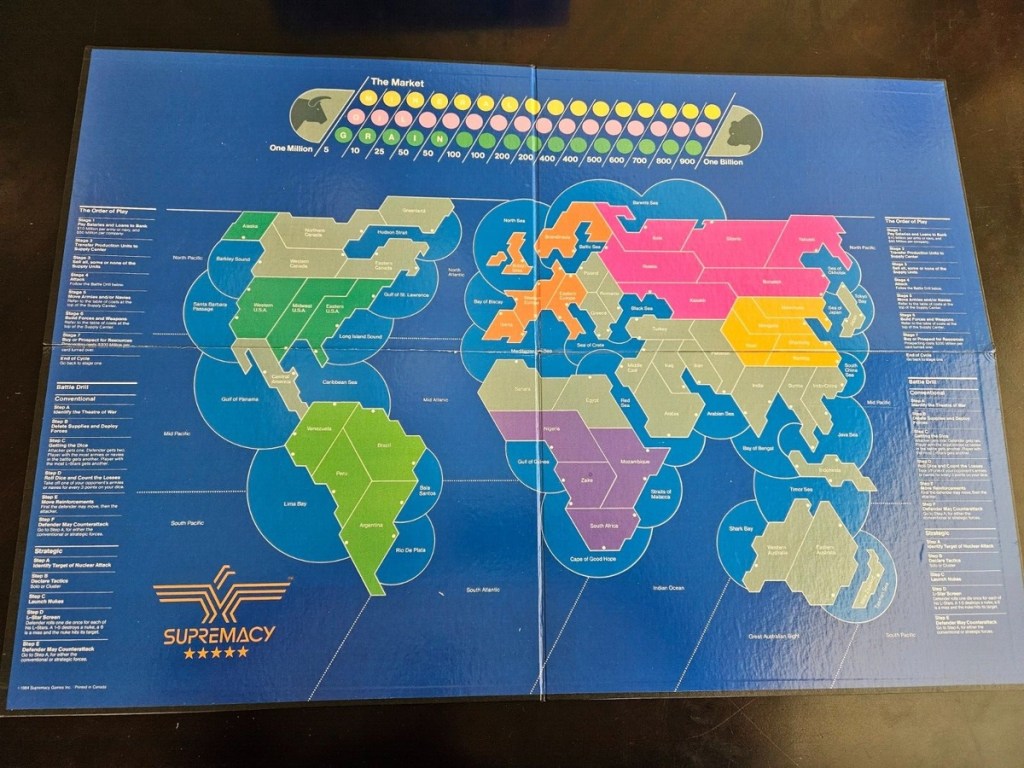
The units are good chunky plastic pieces of simple shapes, similar to Diplomacy, keeping the unit types abstract compared to games like Axis & Allies, Shogun, or many newer games using 3d printed tokens. The types are easy to identify and there is something satisfying with having mini nuclear mushroom to fiddle with. If I had one complaint, it would be of some of the board colours being too close to the colours of the pieces, the pink in particular blending in to the board.
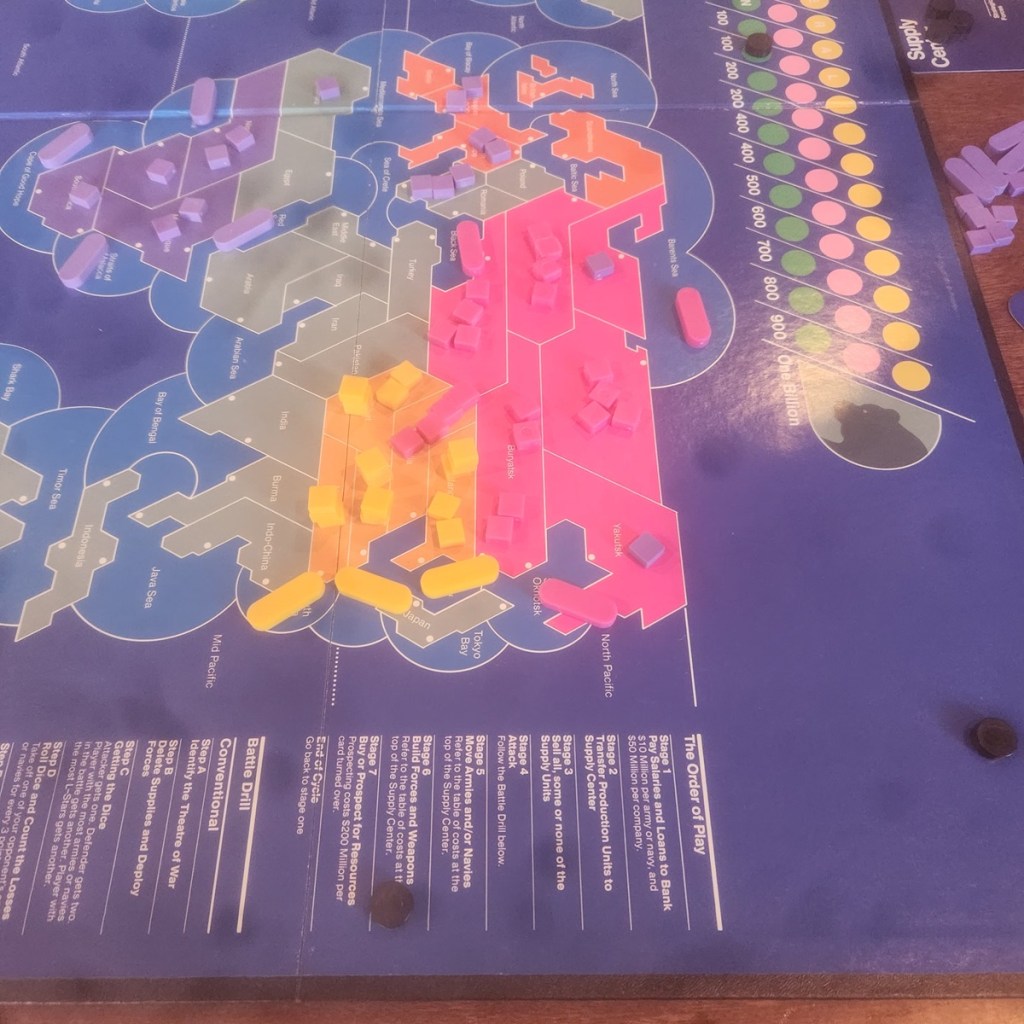
The market was a system that seemed ahead of it’s time, though there were certainly games like Stock Market (Avalon Hill) (1970) that certainly focused on it. The mechanic is simple. There’s a selling phase and later on a buying phase. On your turn you can sell your resources for the current market price. For each resource unit you sell, the market value goes down until it bottoms out. During the buying phase, the market value will go up one spot for every resource unit you buy, up to the maximum market value. There’s a maximum amount you can keep our your player board that manages to keep some game balance. Apparently later expansions have some optional rules to make the market more interesting, like bids for who got to go first (which makes a big difference to what the market value is going to be when it reaches your turn to sell / buy) but I found the simplicity more than enough for the scope of the game.
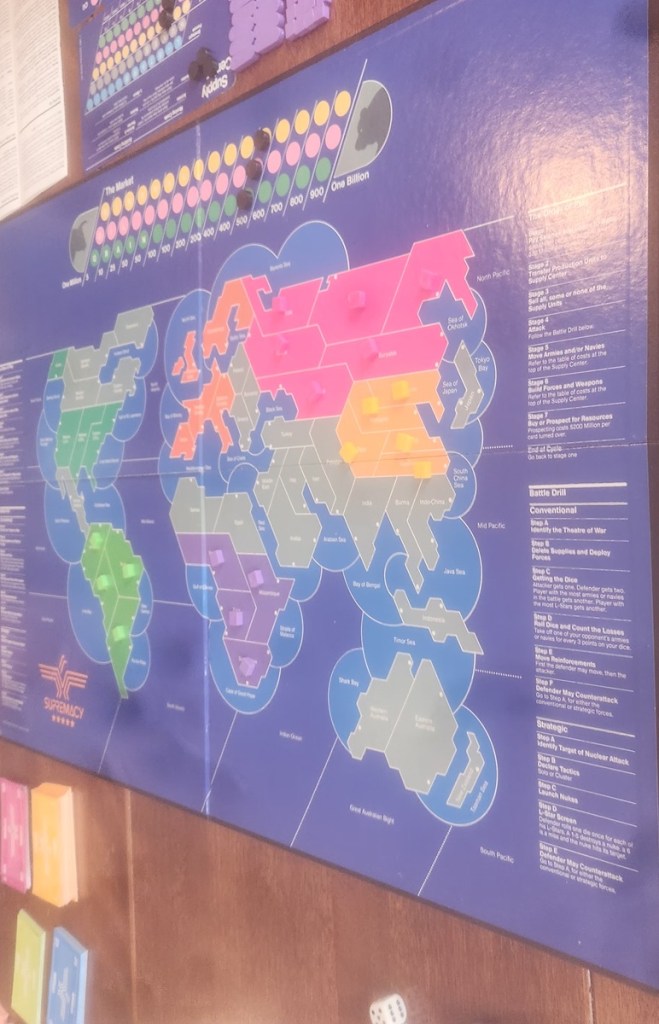
The actual combat to expand your control is pretty much RISK with some minor differences about who has advantage and attrition, plus an opportunity for the attacked player to take a move action after a combat has been resolved. Ships can be used in attacks but are much more useful in transporting units and controlling access to ports. Nukes and the Orbital Lasers have their own phase during the combat action, as you watch the detente of mutually assured destruction build up until finally things get launched. It is possible for everybody to lose the game by having too many nukes activated.
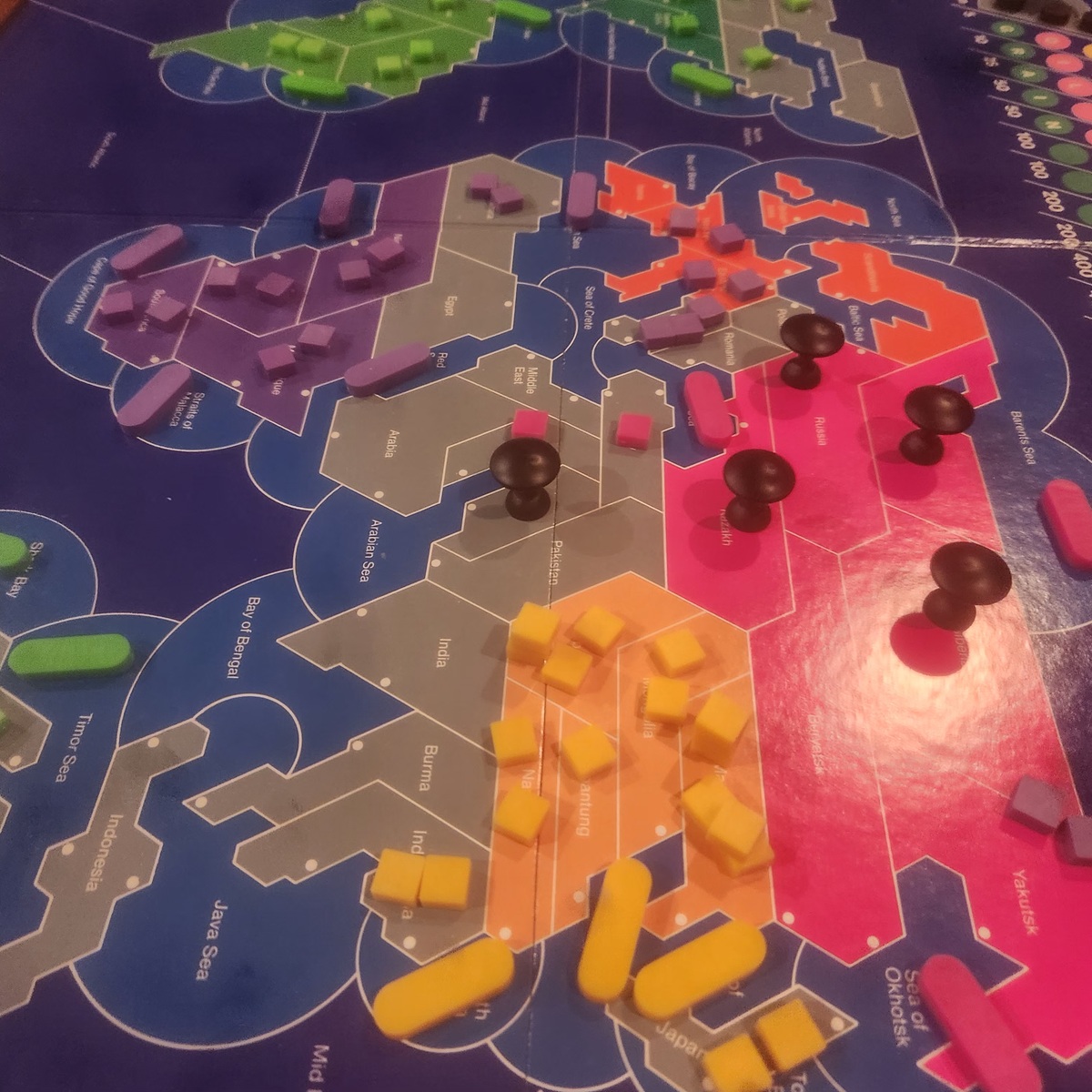
We played to a set time, as that is one of my biggest complaints about games like Monopoly and RISK is the lack of a clear endgame trigger beyond wiping out everyone else. It’s also why I prefer the Monopoly play where the game ends as soon as one player goes bankrupt and everyone else just totals their assets then rather than dragging it out for an unknown number of hours later. Ditto for RISK – I loved that the RISK – Battle for Cybertron had a preset number of turns before victory points were counted. Admittedly, my regular game table is a casual one with lots of snack breaks and side stories about that tv show someone has been watching, so it wasn’t like we tend to be hyper focused on gameplay and that’s all right – gaming is often primarily a social experience with friends and family and it should be enjoyed.
In Conclusion
Yeah, I will totally play this again, armed with some ideas about those optional rules one can find online that help with game balance. It plays up to six, which is an important factor at many a table, and the power blocs are an interesting trip back to the 80s, like another relic of it’s time – Fortress America.
Discover more from A Geek for All Seasons
Subscribe to get the latest posts sent to your email.
 A Geek for All Seasons