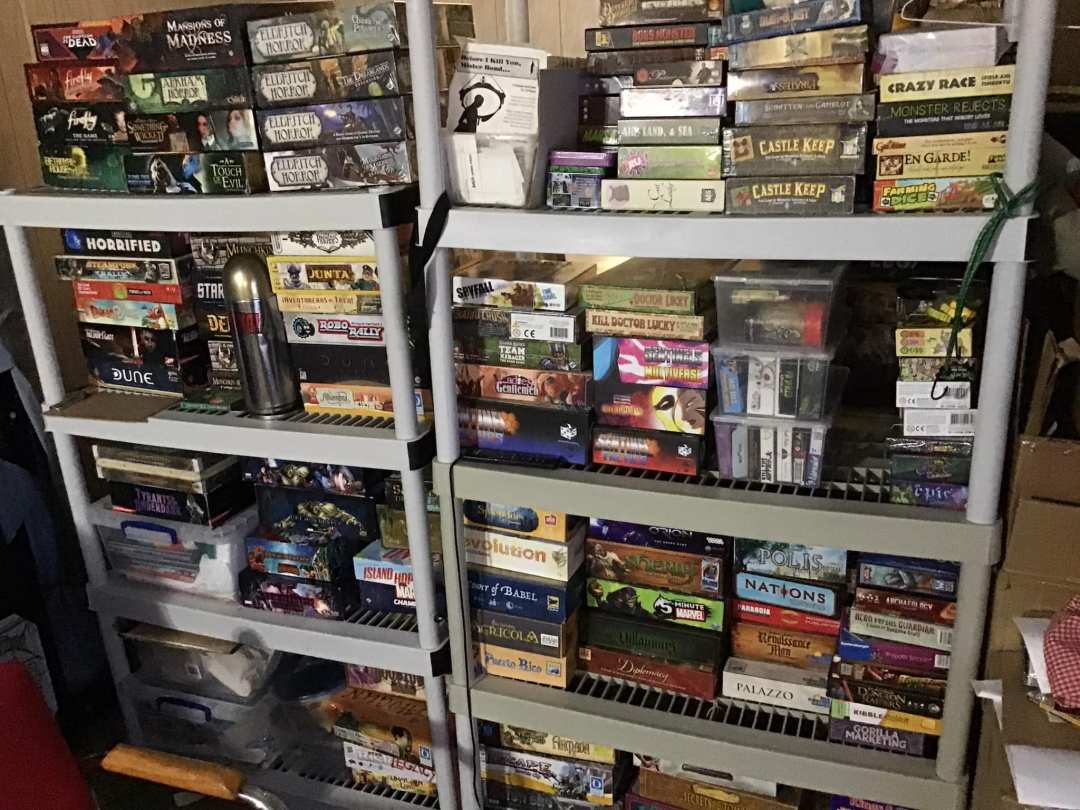
Play 10+ Board Games New to Me
The year isn’t quite over and I’ve managed to get a lot of games to the table. I’m hoping to share some more details about each one during the holiday downtime.
- Disney Gargoyles: Awakenings
Not a bad adaptation of the source material, lots of room for expansions and home brew adaptations of the episodes. There are a few places you might have to make up your own interpretation of rules to make it work, but simple enough to hack that. It captured the feel of the series and for that alone I’d be willing to play again. - Agricola
It’s a classic board game that has eluded me (friends replying “Oh sure, good game but I’m just not in the mood for it”). Manage resources, get victory points, plan on how your resources are going to run out as the next season comes up. - Mouse Cheese Cat Cucumber
If you like computer programming architecture, you might like this one. For others, your mileage will vary. Each player has a secret goal that conflicts with the goals of others. By placing and rotating tiles, you either build a path connecting or blocking (depending on your secret goal). Intellectually, intriguing but less intuitive than say the mad cap Robo-Rally. - World of Warcraft: Wrath of the Lich King – powered by the Pandemic system
I never really played the MMORPG of WoW but I admired the world lore. Like most Pandemic games, it’s co-operative as players race across the board to eliminate threats and complete quests (this time not curing a disease but defeating a region boss) so that they can attempt to defeat the Lich King in a final battle. My buddy who played WoW for some time joyfully analyzed how closely it played out according to lore and was overall satisfied. I’ve played it with several groups of people and they’ve all enjoyed it. The game end conditions are a little different as are some of the card mechanics but I’ll gladly recommend this one. I’m surprised that there hasn’t been an expansion for it yet, but it might have had a soft release as many folks like me were probably leery of a potential cash grab based on IP. Based on this, I’m more inclined to pick up the Star Wars: Clone Wars in the Pandemic system. - Polis
In so many ways, I would call this 7 Wonders Lite. Draft cards and build up your ancient city while waging conflict with your neighbours, but be careful how much to attack them for the ruins created will give them points in the end game. It was an impulse purchase that sat on my shelf for years but once I got it to the table, it was enjoyable. - Princess Bride
It’s a storybook board game, literally. Collect, trade, and play cards to help advance the story to the proper ending. You get a single do over as the grandson tells Grandpa that he’s telling it wrong, which is but one of the many mechanics that nicely captures the feel of the movie. The quotes on the cards, the various adventures of Wesley, Buttercup, and others, and we could not resist uttering most of the movie as we played. Each ‘chapter’ is it’s own board game with goals like get chapter one being Buttercup and Wesley to the barn and complete all Wesley’s chores so he can leave on an Adventure. Another ‘chapter’ is moving around Fezzig and Indigo around the ship while advancing the ship’s voyage to the Cliffs of Insanity, avoiding shrieking eels and other hazards. Ideally, you would play as many ‘chapters’ as you can, as each chapter adds to the available cards so it gets easier to defeat the challenge of the next’ chapter. Over all, more fun than I expected and it might get some more play over the holidays. - Marvel Remix
Not one of the better IP games. The rules are pretty simple for trying to get the best hand you can before time runs out, but the strategy feels more random luck than intent. I only played it once and wasn’t too impressed but I might give it another shot and see if I missed some rule or aspect of play that would improve it. - Tiny Epic Vikings
A solid Tiny Epic Game. In addition to gaining victory points by establishing villages and temples (or by plundering them, because … vikings!), there’s a much subtler secondary game of activating runes and increasing the fury of the Norse gods. It’s the fury that can really score you points in the end game, depending on which god’s favour you carry. Each playing card comes with multiple options that you will hem and haw over how to best play it, be it as a battle card or to take the special leader action or rune action. I backed the kick starter to started off with many god cards and some additional options with the expansion so it’s got a fair bit of replayability with all these elements to change between games and I look forward to the next time it gets to table. - Discover
It was an interesting idea, that every game box would have a unique set of cards (that is to say each set of cards had a few different cards in them to make them unique) and randomly two sets of the four available terrains. It played out okay, but some bits seemed less play tested and left us wondering if we had missed something in the rules or skipped one of the cards. I was interested enough that I went searching for another set to compare (found it cheap at a liquidation store) and will give it another shot. Meanwhile, it might make for some decent random terrain for a Western Marches D&D game. - Takenoko
It’s a cozy game that feels very tranquil, even as you manipulate a gardener and a panda around the board to collect or set up sets of bamboo shoots to meet randomly dealt goal cards. Depending on what you get dealt can make a significant difference in how quickly you can gain points. The better scoring goals are of course the harder ones to set up. I’m willing to play again. We played with an expansion that added Mrs. Panda but it didn’t add that much in complexity, just another option of who to move. - Castle
It’s an older game but still a good one. Winner is the first player to run out of cards in their hands. The catch – the cards can only be placed in certain places in the castle and many of the cards have special abilities that will return cards to player hands. What cards you get is random but the rest relies on strategy of who you place and where. - Viticulture: Essential Edition
Another one of those games that made many a best of list. It plays up to six which was a big selling point for my table regularly hosting 5-6 players. Place workers to develop your wine yard, collect resources, or advance your wines towards being ready to sell. A nice feature is an extra large meeple that can be placed on a spot even if there’s no space for a regular sized meeple. I’m looking forward to introducing it to a few more tables. - Zoo Vadis
It’s a remake of an older game, transformed from the Senatorial race of Ancient Rome into a race for Best in Zoo. Each player has a special ability that can be used twice but it only helps to benefit other players. Relatively quick and once you get the basic mechanics, pretty easy to teach. Another major selling point is that it can play up to 7 players (best at 5 it recommends). I’m planning on playing it again. - Horizon Zero Dawn
Another board game based on a video game, though I was happy with the feel of the original source carrying over into much of the mechanics of the game. Up to four hunters (players) must work together to succeed at series of enemy encounters on a hunting ground but only one will be recognized as the best hunter of the bunch. Alternatively, you can play co-operative (as we did) in a win together and lose the encounter when one hunter is defeated.
Inspired by the excellent podcast, “Into the Meepleverse” and their discussion of gaming resolutions for the year, I decided to make some resolutions of my own including trying to play at least ten boardgames new to me.
Discover more from A Geek for All Seasons
Subscribe to get the latest posts sent to your email.
 A Geek for All Seasons